Introduction
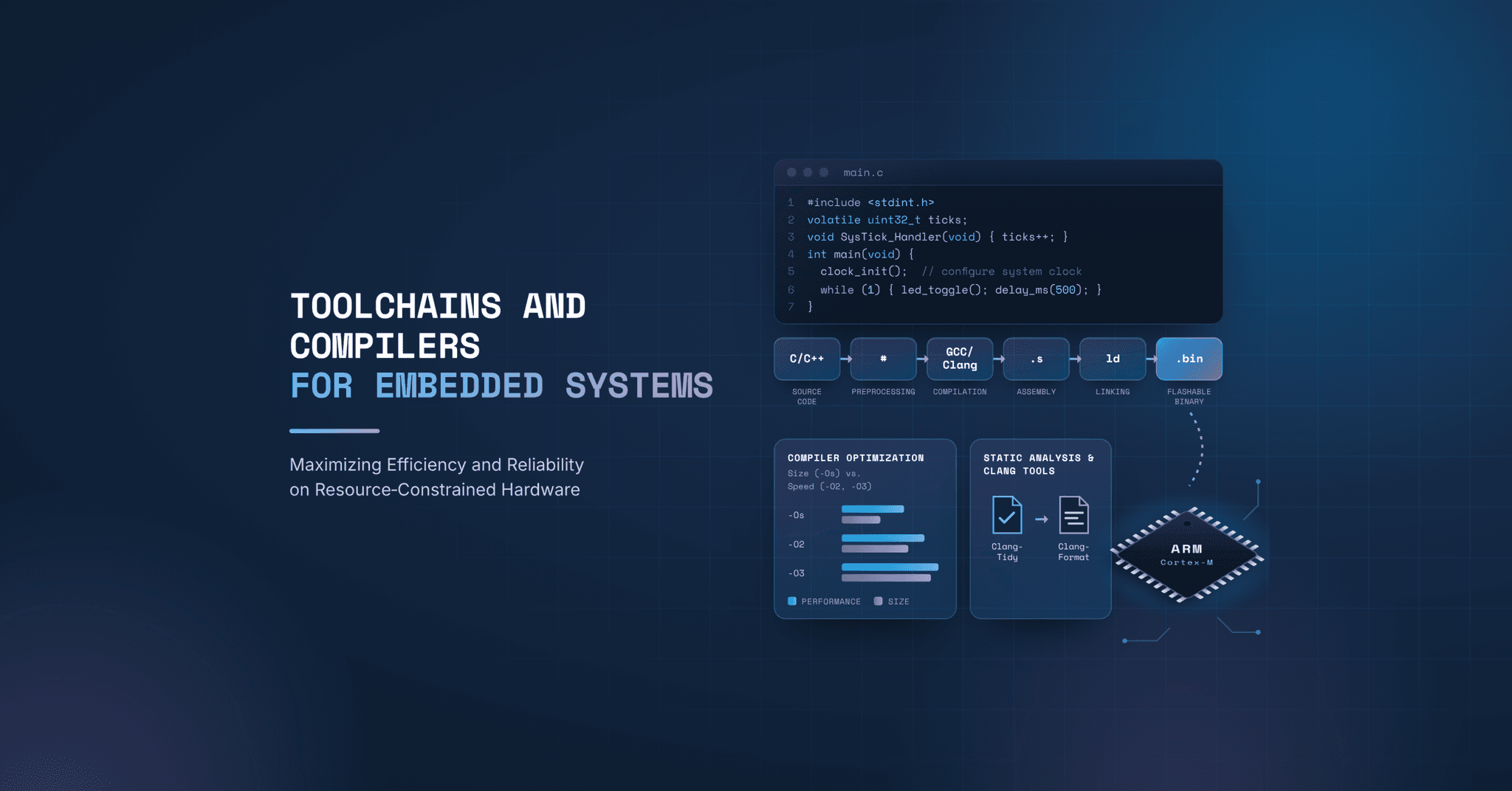
Developing software for resource-constrained hardware requires translating high-level C/C++ code into architecture-specific machine instructions. This article examines the internal mechanisms of embedded toolchains, compiler optimization flags, and static analysis integration. Understanding these elements aids in managing limited memory capacity, optimizing execution speed, and establishing a robust build system.
Background / Context
Before the advent of toolchains, firmware creation was a manual process tied directly to the hardware architecture. Developers wrote software using machine code or assembly, requiring deep knowledge of the specific hardware and memory addresses. This manual approach lacked abstraction, hindered collaboration, and made debugging extremely slow.
The introduction of toolchains provided hardware independence by handling the architecture-specific translation automatically. A toolchain is a sequential collection of tools—preprocessor, compiler, assembler, and linker—that transforms source code into an executable binary. Embedded development predominantly relies on cross-compilation, where the toolchain runs on a host machine (e.g., an x86 Linux PC) but generates binaries for a different target architecture (e.g., ARM Cortex-M). Native toolchains, in contrast, build and execute code on the same architecture.
Main Content / Code Explanation
Step 1: Understanding the Build Pipeline
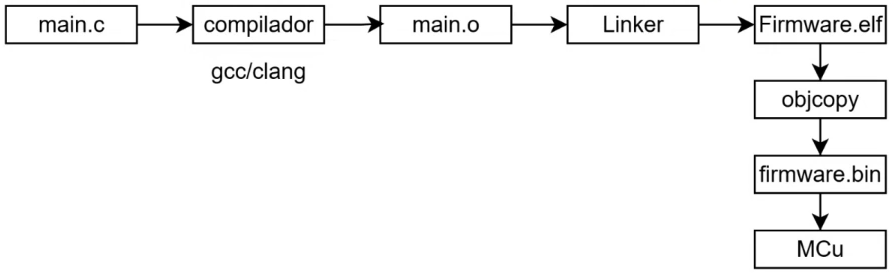
The conversion of source code to a flashable binary involves distinct stages.
1. Preprocessing and Compilation: The compiler expands macros and translates the C/C++ code into intermediate assembly code.
2. Assembly: The assembler converts the assembly instructions into relocatable machine code, outputting object (.o) files.
3. Linking: The linker merges these object files, resolves function and variable references across them, and incorporates standard libraries.
4. Locating/Memory Mapping: Using a linker script, the linker places code and data into the appropriate physical memory regions of the microcontroller, such as Flash for the .text section (executable code) and RAM for the .data and .bss sections (variables).
Step 2: Configuring Toolchains with CMake
Separating the source code from the specific compilation details increases portability across different hardware architectures. CMake toolchain files define the target processor, the compiler paths, and the linker scripts, allowing the same source code to be compiled for different targets without modification.
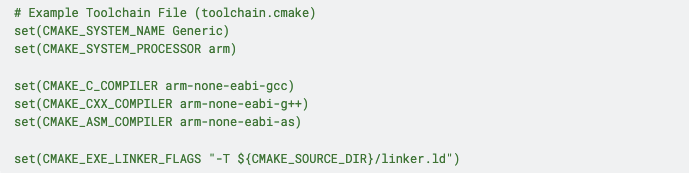
This configuration informs CMake that it is cross-compiling for a bare-metal ARM target (arm-none-eabi) rather than a host OS like Windows or Linux.
Step 3: Compiler Optimization and Binary Size Reduction
Embedded systems often have strict memory constraints, requiring careful selection of compiler flags.
• -O0: letter O, then digit zero (- + O + 0). The flag format is always -O followed by a level, and the level here is 0 (no optimization), which matches the description “Disables optimization.”
• -O2 or -O3: letter O, then digits 2 and 3. These are the speed-oriented levels, and the O in each is the letter, same as in -O0.
• -Os: letter O, then the letter s. This one is the “size” level, which matches “Prioritizes reducing code size.”
Advanced optimizations require instructing the compiler and linker to discard unused code.

The -ffunction-sections and -fdata-sections flags isolate each function and variable into separate sections within the object file. The linker flag –gc-sections drops any section that is never referenced, directly reducing the firmware footprint.
Additionally, Link-Time Optimization (LTO) evaluates the entire project across all translation units. It allows the linker to perform cross-file inlining and aggressive dead-code elimination. LTO increases build times and complicates debugging, making it more appropriate for release builds.
Step 4: Static Analysis with Clang Tools
While GCC is the industry standard for generating ARM binaries, the LLVM/Clang toolset provides superior diagnostic tools for code validation.
• Clang-Tidy: Functions as an automated code reviewer through static analysis. It identifies logic errors, memory leaks, uninitialized variables, and style violations without executing the firmware.
• Clang-Format: Enforces a consistent coding style across the codebase. It automatically formats code according to predefined rulesets (e.g., LLVM, Google), minimizing visual discrepancies in collaborative projects.
Conclusion
Managing an embedded C/C++ project demands control over how code is translated into machine instructions. Defining clear toolchain configurations via CMake decouples hardware specifics from application logic. Applying targeted optimization flags and dead-code elimination reduces the final binary size, while integrating static analysis tools mitigates runtime errors. Selecting the appropriate compilation strategy requires measuring the impact of these configurations on execution speed and memory utilization.
Bibliography
- https://krishworkstech.com/toolchains/
- https://embitude.in/understanding-embedded-linux-toolchain/
- https://microcontrollerslab.com/embedded-systems-build-process-using-gnu-toolchain/
- https://deepwiki.com/nhivp/Awesome-Embedded/5.2-compilers-and-toolchains
- https://tonyfu97.github.io/Embedded-C-Interview-Prep/14_compiler/
- https://tonyfu97.github.io/Embedded-C-Interview-Prep/15_linker/
- https://embitude.in/understanding-embedded-linux-toolchain/
Written by Daniel Avale
Edited by Adrián Evaraldo
For further inquiries, contact us: info@emtech.com.ar