Executive Summary
At EmTech S.A., we develop embedded software systems in highly demanding environments, where delivery quality depends not only on code but also on strict control over toolchains, build systems, and access to real hardware. In this context, remote collaboration introduces additional complexity: distributed teams must maintain consistency across development setups, integration workflows, and validation infrastructure.
To address this challenge, EmTech has built an operational model that enables fully remote embedded development without sacrificing efficiency, reproducibility, or engineering rigor.
Our approach is based on containerized development environments using Docker, where complete toolchains (such as Yocto and Zephyr), debugging utilities, and project-specific configurations are packaged into reusable images hosted on centralized infrastructure. This ensures that every engineer—regardless of physical location—works within the exact same environment, eliminating configuration drift and significantly reducing onboarding time.
Beyond software consistency, EmTech extends this model into a remote embedded laboratory framework. Developers can securely connect to isolated sessions with controlled, exclusive access to physical resources such as development boards, USB devices, and cameras. This enables true Hardware-in-the-Loop (HIL) workflows, allowing real hardware testing and validation to occur remotely as part of daily development.
Crucially, these same environments are integrated directly into EmTech’s CI/CD pipelines. Automated builds, compilation checks, and hardware-backed validation run inside the identical containerized setups used by engineers, ensuring alignment between development, integration, and production-level testing. This reduces late-stage surprises, increases reliability, and strengthens delivery predictability.
Through this infrastructure, EmTech operates distributed embedded teams with the same level of consistency and control as a co-located organization—while gaining the scalability and responsiveness of a remote-first model. This capability allows us to collaborate effectively with partners worldwide, delivering complex embedded systems with high confidence, fast iteration cycles, and robust validation processes.
How Reproducible Development Environments Enable Distributed Teams
Remote software development has become standard across the industry. However, when projects involve embedded systems, custom toolchains, or physical hardware, a recurring concern remains:
Can a distributed development team deliver the same level of quality, predictability, and reliability as a co-located team?
Based on our experience, the answer is yes, but only if development environments are designed, controlled, and operated intentionally.
Why Development Environments Matter More Than Code Alone
In software development, code is only part of the system. The execution environment is equally critical and includes:
- Operating system and version
- Installed libraries and dependencies
- Compilers and toolchains
- Environment variables
- Auxiliary tools such as git, make, python, or build systems
Even small differences in any of these elements can cause significant issues, including:
- “It works on my machine” scenarios
- Errors that appear only in CI/CD pipelines
- Behavioral differences between development, testing, and production
- Bugs that are difficult or impossible to reproduce
While these problems exist in co-located teams, they become significantly more impactful in remote or distributed software development teams, where each developer works on different machines and operating systems.
The Operational Cost of Environment Drift in Distributed Teams
As environments diverge, teams experience:
- Increased internal support and troubleshooting time
- Longer development and debugging cycles
- Reduced delivery predictability
- Strong dependence on specific individuals or machines
- Slower onboarding for new team members
From a business and operational standpoint, this directly affects delivery timelines and reliability — two critical factors when working with remote teams.
Reproducible Development Environments as a Foundation for Remote Work
One key principle has proven essential in our work:
👉 If development environments are not reproducible, remote work does not scale.
Trying to keep environments aligned through documentation or manual setup does not work long term. Instead, the entire environment must be treated as part of the system itself.
A reproducible environment includes:
- The base operating system
- Exact versions of libraries and dependencies
- Toolchains and build utilities
- Defined build and execution commands
When this environment is fully specified and packaged, anyone — including CI systems — can work under exactly the same conditions, regardless of location.
Docker and Containerization for Consistent Development Environments
Docker provides a standardized and practical way to implement reproducible environments.
Using a Dockerfile, teams can define a complete development environment that runs as a container, including:
- Its own filesystem
- Isolated libraries and toolchains
- Development and debugging tools
- Controlled environment variables

Because containers share the host kernel, they avoid the overhead of full virtual machines while still providing strong isolation and consistency.
The result is a single source of truth for the development environment, used consistently across:
- Local development
- Remote development sessions
- Continuous integration pipelines
Embedded Software Development in Distributed Teams: A Real-World Case
At EmTech S.A., we work on embedded software projects that require highly specific environments:
- Heavy toolchains
- Strict Yocto and Zephyr versions
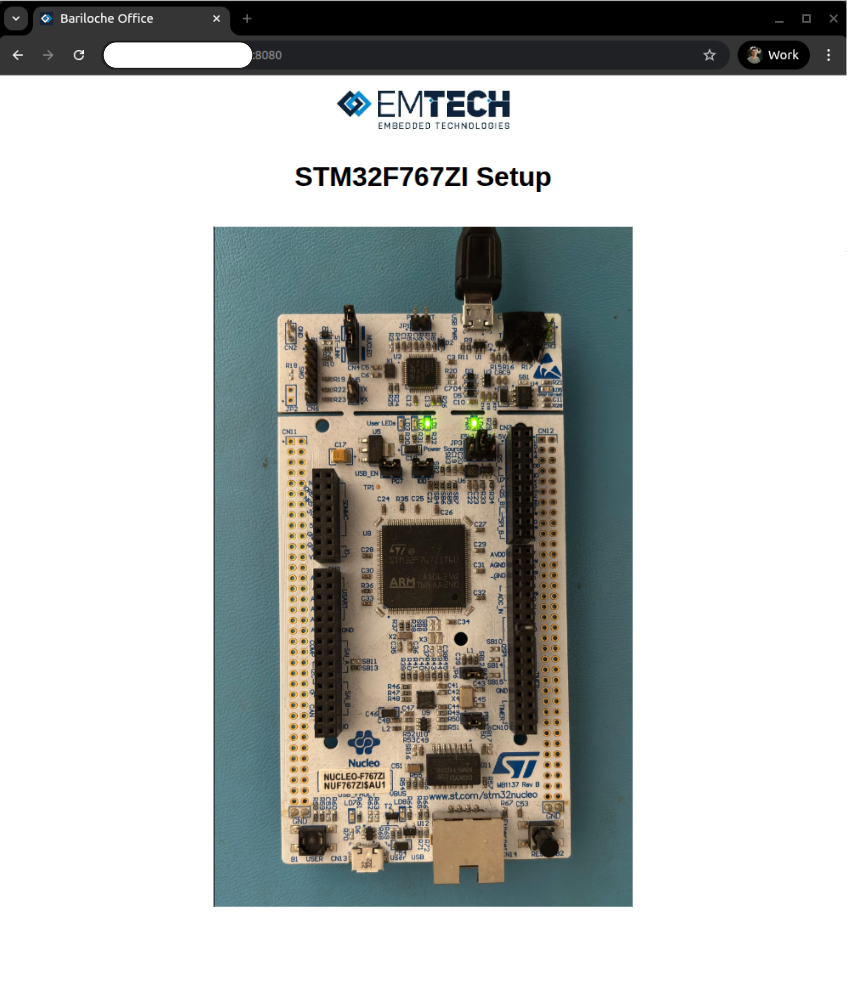
- Access to real hardware such as development boards, programmers, and cameras
When part of the team works remotely — often using personal laptops or connecting from outside the office — maintaining these environments locally becomes inefficient and error-prone.
Installing and maintaining SDKs and toolchains on every machine leads to configuration drift, inconsistencies, and lost development time.
Centralized Development Environments with Distributed Access
Our approach is to centralize development environments while keeping access fully distributed.
We build Docker images that already include:
- Yocto or Zephyr toolchains
- Debugging and flashing utilities
- Common scripts and shared configurations
These images are hosted on centralized servers.
Each developer connects remotely to an isolated working session created from these images.
From the developer’s perspective:
- No local setup is required
- The environment is always consistent
- The physical location is irrelevant
Whether working from the office, from home, or from another country, everyone uses the same development environment.
Remote Hardware Access and Shared Embedded Laboratories
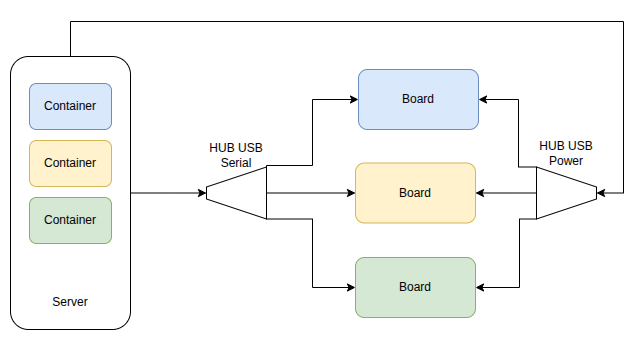
One common limitation of remote embedded development is access to physical hardware.
To address this, we treat hardware as a managed, shared resource. Each working session can:
- Run in complete isolation
- Be assigned exclusive access to specific USB devices or cameras
- Prevent conflicts between multiple users
This enables a remote embedded laboratory model, where developers can work with real hardware without being physically present.
To simplify usage, automation scripts handle common tasks such as:
- Creating and destroying sessions
- Mapping hardware devices
- Managing resource allocation
Docker remains an implementation detail rather than a barrier for daily work.
Aligning Development and CI/CD Environments
The same containerized environments used by developers are also used in CI/CD pipelines.
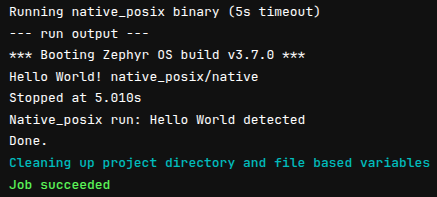
Automated builds and tests run inside the same Docker images, using identical toolchains and configurations.
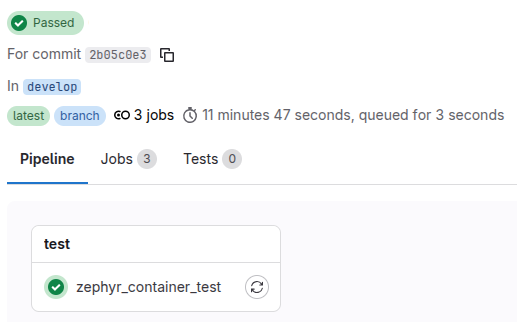
This alignment significantly reduces discrepancies between development and integration environments and improves confidence in test results.
Faster Onboarding for Remote Developers
One of the most visible benefits of reproducible environments appears during onboarding.
A new team member can:
- Connect on their first day
- Open the project repository
- Build and run tests immediately
- Access real hardware if their role requires it
All without installing SDKs, toolchains, or specialized software locally.
This dramatically reduces onboarding time, lowers support overhead, and allows new contributors to become productive quickly — even in a fully remote setup.
Reliable Remote Development at Scale
Remote software development does not have to imply:
- Less control over quality
- Higher operational risk
- Fragile development processes
With reproducible development environments and proper infrastructure, physical distance becomes irrelevant.
At EmTech S.A., this approach allows distributed teams to work with the same level of consistency, predictability, and technical rigor as co-located teams — and often with greater efficiency.
Written by Emilio Bascary
For further inquiries, contact us: info@emtech.com.ar